Sign In:
Talking Heads

Talking Heads

Bio

[Edit this profile]
One of the most critically acclaimed bands ever, Talking Heads’ 1979 album Fear Of Music has spawned a young band and a south-east London clubnight of the same name, but their influence can be heard all over modern music - perhaps most notably in Franz Ferdinand or Bloc Party’s jerky pop, or Dogs Die In Hot Cars’ yelping vocals, off-kilter lyrics and offbeat rhythms. Tom Jones has unfortunately created musical excrement in the form of a cover of Burning Down The House. We shall ignore that.

Forming in 1975 and eventually disbanding in 1991, Talking Heads managed to produce a remarkable body of work in that time. They were one of the original white-boy intelligent art school funk-punk bands, and in Tina Weymouth they had one of the most influential bassists in rock music.

David Byrne (vocals/guitar/creative genius) met Weymouth and drummer Chris Frantz at Rhode Island School of Design, with Byrne and Frantz subsequently forming a band called The Artistic/The Autistic, playing ‘60s covers and the occasional original which even then included future classic Psycho Killer. After graduating they moved to New York, where Weymouth learnt the bass and the three of them eventually settled on the name Talking Heads, spotted in a copy of TV Guide. They made their live debut in ’75 supporting The Ramones at CBGBs. It could be said they were in the right place at the right time: New York was on a roll with new, arty, Velvet Underground-influenced bands and singers popping up everywhere (check out the most excellent book ‘Please Kill Me’ by Legs McNeil and Gillian McCain for the verbal history of this time).

They signed to the Sire label in 1976. The next year they gained a keyboard player by the name of Jerry Harrison (formerly of The Modern Lovers). After a UK tour that year they were spotted by slaphead weirdo Brian Eno, who would eventually become creatively involved with the band to much joyous results.

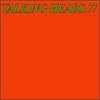
Despite critical praise foisted upon it, the band weren’t so happy with their debut album Talking Heads ‘77, but with Brian Eno now at the producer’s helm they thrust second album More Songs About Buildings And Food upon the world, even managing to pull off a cover of Al Green’s Take Me To The River without making absolute tits out of themselves. It was ‘78s Fear Of Music which saw them expand their sound even more, taking in influences from African music and using additional musicians. Despite all this, Byrne set about a solo career in parallel with the band.

1980’s Remain In Light saw another turning point. Produced and co-written with Eno again, it saw the inclusion of the formidable Once In A Lifetime, which also spawned one of the greatest, most original pop videos ever where we see Byrne spazzing out over a white background and images of religious worshippers. Norman Cook/Fatboy Slim recently cited it as his all-time favourite song.

Not to be outdone by Byrne’s solo success, Frantz and Weymouth jumped on side-project bandwagon with Tom Tom Club, who scored a UK Top 10 single with Wordy Rappinghood. Harrison made an album called The Red And The Black and Byrne put his creative output into a ballet and producing a B-52s album. But Talking Heads were not on the back-burner…

Eno had become synonymous with Byrne so was dumped as the band’s producer and they self-produced 1983’s Speaking In Tongues, containing Burning Down The House and This Must Be The Place, proving Eno wasn’t massively missed. Things took a more bizarre twist for the better in December that year when a meticulously choreographed concert at the Pantages Theatre in Hollywood was filmed by Jonathan Demme, becoming what many people regard as the greatest rock movie ever in ‘Stop Making Sense’. From the opening scene of Byrne alone on a big stage, playing Psycho Killer on acoustic guitar along to a beat-box, each musician joins him song-by-song. As it goes on, he eventually dons his now-famous Big Suit. It is ace.

Two years later they released Little Creatures, perhaps their most accessible pop album with the singles And She Was and the glorious Road To Nowhere. Another famous producer, Steve Lillywhite, was drafted in three years later for Naked, which saw them return to the African-influenced beats. It turned out to be their last album together and all the solo projects took off again, with Byrne also setting up a world music label, Luaka Bop. Byrne officially announced the split of the band in December 1991. The world did weep.

Somewhat cheekily, Weymouth, Frantz, Harrison joined up with T. ‘Blast’ Murray and Deborah Harry to form The Heads, who released a well-received album No Talking Just Head in 1996. Byrne continues to receive critical acclaim with every gig he does, often throwing in Talking Heads classics.

by adie nunn, january 2005

See Also

    User Ratings

    Rate this artist:
    [guide]