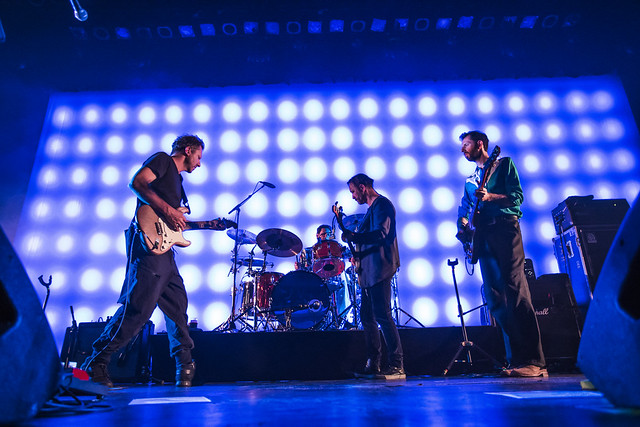
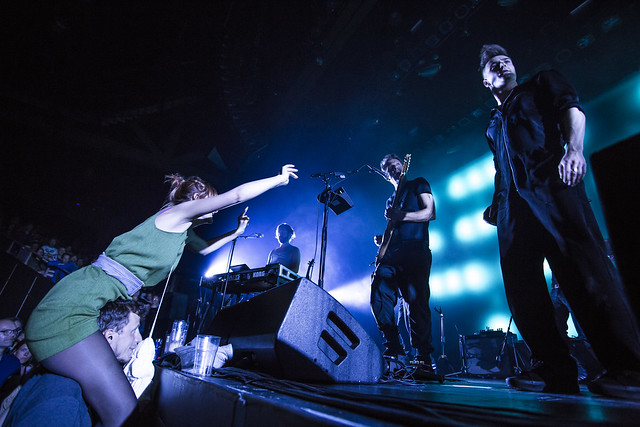
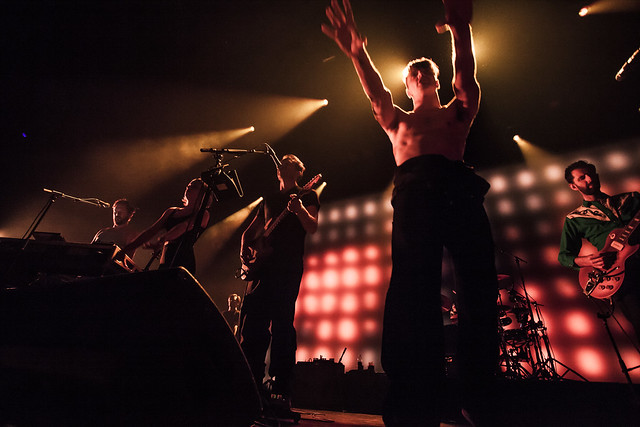
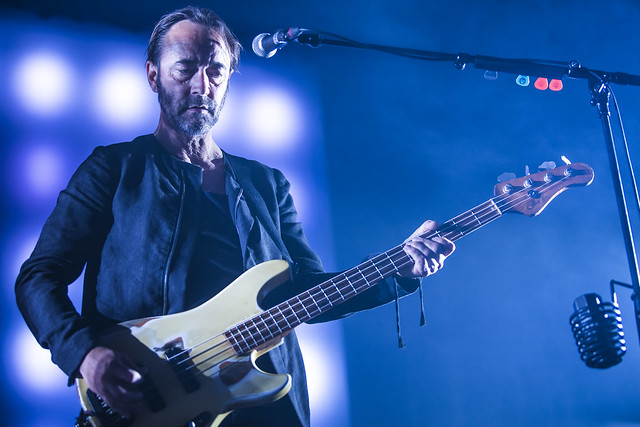
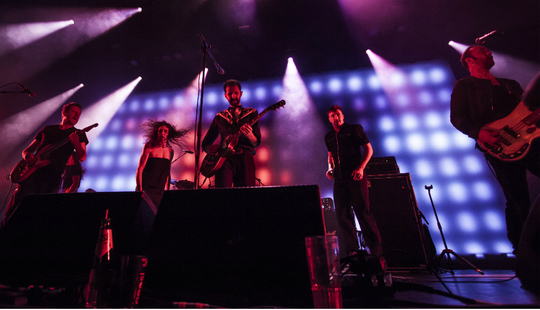
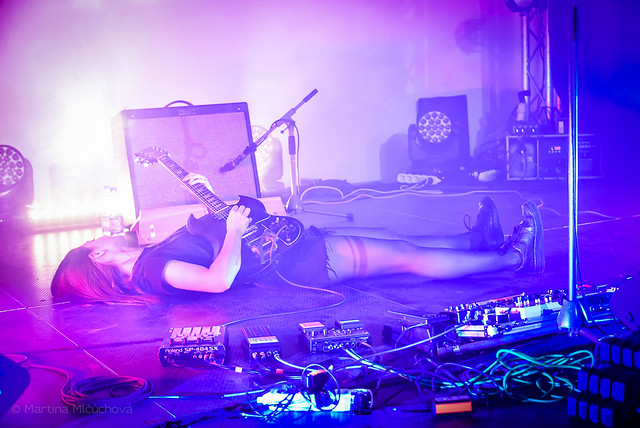
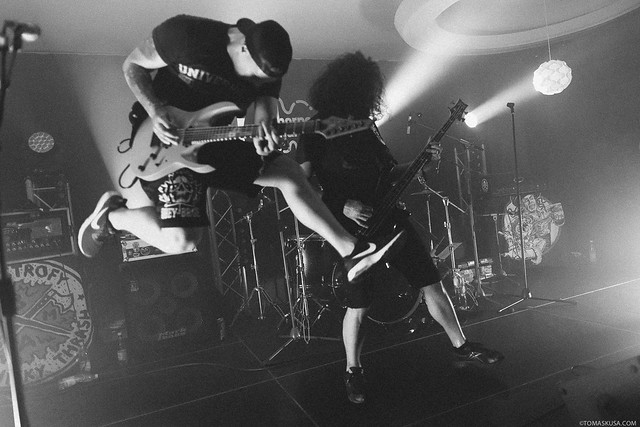
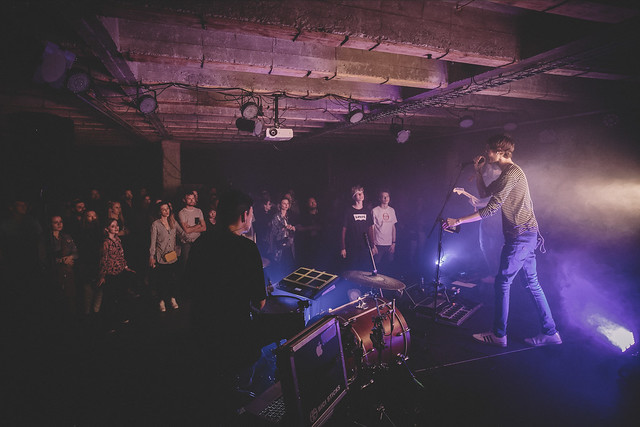
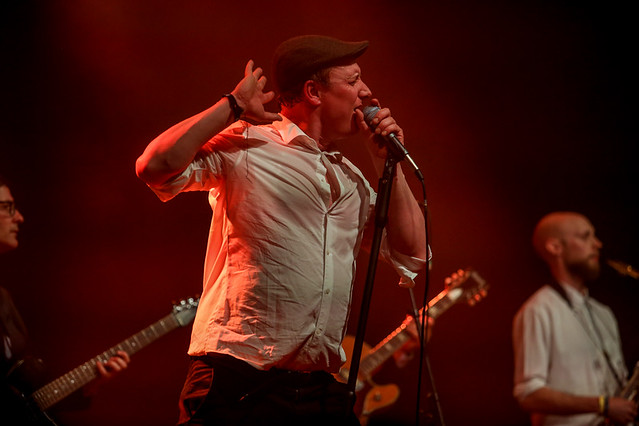
In this review of the festival, we've not tried to cover everything (there were well over 300 acts, after all). Instead, what you'll find below is DiS' editor's picks of the weekend (that's me writing this intro, hello!), but first, DiS' David Edwards who trekked down from Manchester shares his picks of the weekend...
My first time ever in Brighton and my first Great Escape, and I left having been hugely impressed by both. It’s hard not to be taken in by Brighton’s charm: full of atmosphere, vibrancy and energy. And the same proved true with the music over the weekend - the quality rarely dropping below a high class and calibre. I’d certainly do a few things differently next time, such as planning with caution rather than quantity in mind. This certainly proved a downfall at some points on the Saturday afternoon, where certain shows (Hey Sholay, Parma Violets) were nigh-on impossible to get into if you didn’t have one of the ultra-delegate wristbands. And I’d certainly invest more time in checking out some of the further flung and Alternative Escape venues next time…some of the stuff at the fringe events was quite brilliant, but there were a couple of Brucie Bonuses attached to the weekend. Like finally getting to meet Michael Eavis and ramble to him about all the great/inspirational/drunken times I’ve spent on his farm. He’s a lovely guy! No tip-offs about 2013’s headliners, mind…
...and then on Saturday afternoon, myself and Drowned in Sound stalwart Dom Gourlay (you'll find his review over on ContactMusic) managed to put in a sterling performance alongside fellow music geeks Joel, Lorraine and Ian to clinch a hard-fought fourth place finish against sixteen other teams of assorted industry, media and TV types for John Robb’s Pop Quiz (a sterling knowledge of Big Black, Dave Dee, steam-powered dildos and Girls Aloud assisting us along the way). Our prize? A copy of Duff McKagen’s “It’s So Easy (And Other Lies)” autobiography. So far (19 pages in) he’s lost his virginity, christened Guns ‘n’ Roses tour jet by smoking crack with Slash on the runway and had his pancreas explode. This promises to be an entertaining read…

Ultimately, the schmoozing, boozing and losing of our sense of time all came second to the excellent music on offer. So here are my top five acts of The Great Escape 2012. Not in any sort of ranking. Just the order I scribbled them onto my phone while watching. This naturally, happens to be chronological. Funny that…
(Green Door: Friday 00.45)
What you really need at the end of a long, busy, exhausting and perma-boozed afternoon is something with the illicit energy of a North Korean “secret warehouse” to revitalise and reinvigorate. And my word; Zebra and Snake didn’t disappoint in that regard. They give us slutty, seductive and thrillingly dirty synth sounds rammed aggressively up against clattering, chugging bass and softer, almost cushioning beats. The collision between the three produces a sound that is simultaneously sensual, snarling and soothing. It’s woozy but thrilling; challenging yet rewarding. The fact that the two of them seem so overtly focused on throwing everything they have at the tools of their creating while the front rows go off on one only adds to the sweat-soaked atmosphere as Day One draws its way towards a triumphant, euphoric and semi-revelatory conclusion as they oscillate between sonically cuffing and caressing us. That’ll do just nicely, thank you very much! // zebraandsnake.com
(Life Bar: Saturday 18.00)
Me and FOE go back a while. Well, to October last year anyway (as in politics, that’s a long time in music) when I saw her play her terrific brand of crunching and genre-bending pop-fuzz-punk to a handful of people in Manchester’s Factory. After the show, I gabbled something nonsensical at her about how great she was and how small turnouts shouldn’t put her off her vision. I may have sounded like an idiot at the time but on the back of her marvellous debut record Bad Dream Hotline, seeing Life crammed to capacity with folk waiting outside was a vindication of what she does. Except Hannah Clark and her band aren’t happy to simply settle for this. Oh, no. Her Great Escape set was predominantly characterised by a wicked confidence in both sound and performance; the songs supercharged with spitting static and already assuming new forms and presentations. Her band have grown astronomically since I first witnessed them and almost seem to take the pressure off her; so impressive are they at wrapping a tarpaulin of sheer intensity and rock and roll bravado around what could otherwise end up as something whimsical. And as for Clark herself, she’s developing that coquettish, maddeningly difficult to pin down, ultra-confident stage persona that denotes the borderline of “kooky” into “genuine star quality”. She’s so good, she even gets away with not playing ‘Cold Hard Rock’ in place of a new song that sounds like an intelligent and instantly memorable stride forward towards deserved mainstream attention. She’s growing; the songs are growing; the performances are growing too – in both size and ambition. Turn the page and watch…this was superb. // foe-mania.tumblr.com
(Coalition: Friday 19.15)
To upstage the epic live reputations afforded to We Were Promised Jetpacks and The Twilight Sad (both playing alongside them on the Fatcat Records stage) is no mean feat. But it’s one that Odonis Odonis pulled off impeccably as the sun began to sink behind the skeletal frame Brighton Pier on Friday night. The Canadian band are almost like a re-interpretation of The Jesus and Mary Chain’s Darklands album, as imagined by Queens of the Stone Age but with Joey Santiago guesting on guitar to drag the whole thing that bit closer to the surf. Singer Dean Tzenos’ fuzzed-up and echoing cries perfectly juxtapose with a soft, ethereal backing that steps in when things become that little bit too confrontational. They’ve got influences pinned notably and clearly to their sleeve, sure. But should that really matter if the music and performance is this viscerally thrilling, jarring and (occasionally) terrifying? Not at all. A striking and intense show; perfectly kicking off an excellent line-up of bands stretching across the evening at Coalition. But on this occasion, the page-boys crashed the party… // odonisodonis.com
(Green Door: Saturday 13.30)
There is always one band at a festival who - having never even heard of before – you leave rabidly yammering about a) how brilliant they are and b) how everyone needs to hear them. For me, and for The Great Escape 2012, that band happen to be The Naturals from Bristol. Early morning in the cobblestoned stable atmosphere of The Green Door, what seemed a routine “let’s check them out” turned into one of the highlights of the weekend. It’s easy to detect overtones of Godspeed! You Black Emperor and early Hope of The States in their extraordinary ability to draw sheer blood, sweat and waves of heart-breaking memories from your soul with sound alone; it’s easy to hear echoes of Foals, Battles and This Town Needs Guns in their ability to layer intense and hypnotic melodies, rhythms and patterns on top of each other. But what they do is all their own and the manner and confidence in which they make the stage incontrovertibly theirs is stunning. They finish the set on their knees conjuring up an overwhelming wave of feedback and effects from their multiple pedals, before leaping to their feet to crash seamlessly back into the song with twice the energy of before. My headache is gone; my hangover scampers for cover and I’m throwing myself around with a sheer joy for life and music. Absolutely magnificent. // FaceBook
(Life Bar: Saturday 21.00)
What a glorious hybrid of strange wonder Stealing Sheep are. Three attractive, mysterious girls from Liverpool playing a triumvirate of Fender Stratocaster, Keyboards and thumping, blasted-heath standing percussion; the combination of which is an intensely heady sweet smoke of friend-bracelet entwined melodies; married to a complex and turbulent maelstrom of lo-fi growl and atmospheric bliss that becomes even more hypnotic and translucently beautiful after a time. What however, is even more impressive about Stealing Sheep is that they use these pretty garments to dress a frame of genuine substance. They have glorious folk-pop songs that carry sharp and intelligent twists with every measure. And in adding a truly unique sound and colour to this appreciation of great psychedelic pop music, they manage to stand out effortlessly from peers who simply think it’s enough to turn up with a good look and a selection of pedals. Make no mistake; this is difficult music to create. Thankfully for us, it’s also quite spellbinding to appreciate. // stealingsheep.co.uk
And as an extra, my pick of the acts from The Alternative Escape…
(The Queen’s Head: Friday 20.30)
There are a slew of excellent bands (The Janice Graham Band, The Louche, Beat The Radar) reaching out beyond the traditional template of what Manchester can achieve with a guitar or two. But on this occasion, recent arrivals on the scene Shinies stole a march with a quite magnificent show downstairs in The Queen’s Head. They belie their youth with a perfect understanding of the chemistry of colour-fuzz pop music over the last 20 years; concocting a muscular, ever-inventive and perfectly balanced hybrid of Dinosaur Jr., The Pains of Being Pure at Heart, Teenage Fanclub and the more pop-orientated moments of The Pixies. But there’s also (appropriately) a sense of the English seaside and a desire to escape in their music…a yearning which adds a turn and tone of melancholy to the otherwise bright and bold sound. Equally importantly, they know when to drop the cuter stuff and simply blow steam, with their songs often ending in a pummelling squall of feedback and reverb. Despite their status as relative newcomers, they’re almost the full package even at this early stage and with songs this instantaneous, bold and confident, you can easily see them breaking through in the very near future. And if they do, they’ll snag many a musical heart on their hooks. shinies.bandcamp.com
---
I feel like some sort of Great Escape veteran. I've been to the festival every year since its inception in 2006, and DiS has hosted a stage every year too. By 'hosting' what I really mean is to-froing with the organizers for about six months, trying to put together a bill of bands from around the globe that we love. You could be grand and call it "curating" if you so wished. Essentially, it's a bit like playing fantasy festivals, only the thing actually happens. Obviously there isn't the budget for like Bjork supported by Aphex and Deftones. Not that that hasn't stopped us trying.
This year I ran around like a blue-ass fly, saw bands, chatted about the future of the music press on a panel, DJ'd a blog party, drank beer until the sun came up and ate a dodgy sausage (this is not a euphemism, but then when in Brighton...). These were the things I loved the most of the 30 or so acts I managed to catch...
Growing up as a skate-punk loving BMX-riding dweeb, I never thought I'd ever become the kind of guy who breaks down in tears to the sound of a piano. I didn't think I'd ever fall under the spell of music that plays with the shadows of silence. Maybe it was the utterly grand setting of a mini-cathedral (designed to make you feel humble), but this was one of the most moving things I'd ever seen/heard/felt. Incredible. I'm getting chills just thinking about it, and I think my heart genuinely aches after watching that ...the A Winged Victory for The Sullen set which followed was equally immense, but I felt absolutely emotionally drained after Nils' set, and that's the only reason why that isn't one of my picks too. Erased Tapes, happy fifth birthday, and thank you for bringing this beauty to Brighton.
I had a feeling this would be a highlight but I wasn't quite prepared for how widescreen the guitars would be. I mean, I should have anticipated that the man who wrote The Stills' debut album would bring some big U2-bothering guitar parts but the rhythms (Justin Peroff, what a dude!) and synth textures on their debut record had me thinking this would be far more slight. If you loved Burst Apart as much as I did last year, you need these Canadians in your life... My scribbled notes for the show simply read "underblown" and I think that just about sums it up.
Gemma Hayes, on her own, with an acoustic guitar, and THAT VOICE. Breathtaking. Such a treat.
David said it all really above, but this was a great show and then some. Someone put FOE on the road with Uffie, The Kills, Metric, Paramore, and however else's crowd appreciates riffs that snarl, lyrics that bite and electrocuted melodies that fizzle in your mind the morning after. A truly unique and most definitely British talent.
Was a little bit bemused by these guys on record, but oh my gosh, live it's like some sort of psychedelic-stadium-rock-party. Think ...And You Will Know Us By the Entrails of Flaming Lips, and then double it. Pretty much exactly what every 'buzz' band should be live, with a slice of Beefheart on the side.
I'm not sure I can really pick a favourite band from DiS' bills but there was a moment during WSGM's set when limbs were flailing in all directions and the bass boomed through my chest, when I pretty much could have gone deaf for life and not cared a jot. It was a moment of pure elation. Bliss. Serious bliss from start to finish, especially when everything falls away and his voice crawls around the room like a pirate's cat, all Antony goo with ...Cuckoo Nest coos. This is everything you want a live show to be, but it was far too short, and I'm really sorry about that (not that it was DiS' fault, the gig in the venue before over-ran, which meant no-one really got a soundcheck, and the venue had to kick everyone out for a club after, so we couldn't steal extra time!)
My final pick is also from our Saturday night DiS bill (sorry, I did see other people's bills, but I guess I did really pick all my favourite acts of the past 12 months, so it's probably no surprise they were highlights). This husband-wife duo have been making my heart stop, quiver, shiver and fill with purply-pink pixelated joy for quite some time. Their mixture of ice cool Prince-ish rain, with the sort of science fiction rnb seemed perfect on Digital's dark dancefloor. For something so slight, this was so pulsating and powerful that the disco in my mind's eye was twirling throughout.
---
My five highlights of the weekend...
...played a South African Hip Hop reworking of Joy Division...?
...Samantha Urbani stalking through the crowd while singing Friend Crush - at the end of Brighton pier.
...playing Krautrock for the people
Grimes & her backing dancers losing their shit...
The first 20 minutes of College's DJ set being as transcendent a DJ set as I've seen since Daft Punk in 2007 (It got a bit drum-heavy for my taste towards the end)
We've shared ours... who were your picks of the weekend?
]]>

“Little by little my prejudices against classical music began to fade away ... It came as a sheer revelation to me. It is impossible for me to describe the enthusiasm, the ecstasy, the intoxication which I was seized by.”
Who said this? From the way things have been going recently, you’d be forgiven for thinking that it was Damon Albarn, who’s just finished his second opera. Or maybe it was Jonny Greenwood, who’s been collaborating with Polish composer Krzysztof Penderecki. Or perhaps it was Owen Pallett, who recently premiered a violin concerto in London. On the other hand, it might have been St. Vincent, who has been known to write chamber music occasionally. Then again, it could have been Elvis Costello, who wrote an entire ballet a few years ago. All of these would be sensible guesses. But, as you’ve probably guessed by now, it was none of those people. In fact, it was none other than Pyotr Ilyich Tchaikovsky, who is the focus of this month’s article. As with the previous articles in this series, I’m going to be introducing some of the most important works of this great composer in a way which will hopefully be accessible without being patronising. I don’t come from a classical background (I can’t even read music), and up until a couple of years ago I knew virtually nothing about the subject. I know what it’s like to come to this music without any prior knowledge, and how vast and intimidating the classical repertoire can seem. So believe me when I say this – there are centuries of amazing sounds just waiting to be explored – all you have to do is listen.

In previous editions of The Classical, we’ve been racing around different periods and styles without much sense of the connections between them. So before talking about the music itself, we need to fill in some of the gaps between Beethoven’s death in 1827 and the start of Tchaikovsky’s career as a composer in the 1860s. Beethoven ushered in the new era of Romanticism, where personal expression, rather than the demands of patrons, became paramount. Orchestras got bigger, and the instruments they used became more varied. Composers like Schubert, Chopin, Schumann and Mendelssohn began to explore the new musical vocabulary which had been opened up by Beethoven, while at the same time rediscovering the technical mastery of Baroque composers like Bach.
It wasn’t long, however, before splits began to appear in the German musical community – the so-called War of the Romantics began, pitting “progressive” composers like Liszt and Wagner against the more “conservative” Brahms. The reality, of course, was more complex, but we’ll discuss that another time. Both sides claimed to be carrying on Beethoven’s legacy, but the methods they chose differed. Liszt invented the “Tone Poem” (a single-movement orchestral piece which tells a story) and wrote explosive new piano works while Wagner worked on epic music-dramas. Brahms, meanwhile, reinvigorated traditional forms like the symphony and the concerto. The basic dispute between them was whether music should be “programmatic” or “absolute” – should it try to be like a novel, filled with themes, characters and stories, or should it remain purely abstract and concerned only with its own internal, formal logic?
But that was Germany, where people were sometimes overly serious about music. The situation in Russia was a little different, and so were its musical traditions, which were based on a cappella religious music. The debates happening in Europe were taken up in Russia to an extent, but for many musicians the problem was Europe itself – should Russia try to keep up with development there, or should it forge ahead with its own unique national style? The Rubinstein Brothers, who ran the St Petersburg Conservatory, belonged to the traditionalist, westward-looking camp, while in Moscow a rival group of composers called “The Five” (no prizes for guessing why) were formulating new music with a uniquely Russian flavour, drawing on native composers like Glinka while at the same time looking eastwards for inspiration.
So where exactly did Tchaikovsky fit into this complex situation? Well, the short answer is that he didn’t, and perhaps that’s what makes him so great. There’s a moment in one of Tchaikovsky’s operas where a group of aristocratic ladies take a break from listening to dreary ballads and decide to sing a lively folk song instead. But before they really get going they are interrupted by a stuffy older woman who tells them to stop, and asks them – “are you not ashamed to dance Russian style?”. This brief moment beautifully illustrates the many conflicting forces which influenced Tchaikovsky’s music – high and low, east and west, classical and folk, private and public, past and present, propriety and emotion.
Tchaikovsky studied with the Rubinsteins, but he also knew and even collaborated with The Five. He was also extremely independently-minded, with very particular tastes – he thought Brahms was too serious, but also had very mixed feelings about Wagner, and often avoided the debate between them altogether by opting to listen to French ballet or Italian opera instead. Most of all though, he was obsessed with Mozart – the quote from the start of this article actually refers to Tchaikovsky’s childhood love of Mozart’s opera, Don Giovanni. Tchaikovsky even referred to Mozart as a “musical Christ”. This cocktail of influences made Tchaikovsky one of the most distinctive composers of the Romantic era. His music almost always possesses an incredibly high level of drama and emotional intensity, mixing saccharine sweetness, sweeping grandeur, rococo ornament, patriotic simplicity and, sometimes, poignancy and despair.
As a result of his idiosyncratic approach, the highly sensitive Tchaikovsky received both praise and criticism from virtually all sides, and worked to please himself rather than conforming to any particular school of thought or musical dogma. The fact that Tchaikovsky was gay meant that sadly, for much of the 20th century, many critics derided his music, often basing their reviews on offensive stereotypes and fear of his popularity rather than meaningful analysis. Tchaikovsky’s talent for making an immediate emotional connection with his audience lead to accusations of vulgarity, sentimentality and bombast. His occasional avoidance of some traditional methods of composition, such as development and sonata form, were also highlighted as failings. But where some saw mistakes, others saw originality.
Like Rossini or Johann Strauss II, Tchaikovsky was someone who was unafraid of producing pure entertainment, but also made huge and anguished musical statements. He never shied away from doing something vaguely ludicrous if it achieved the right effect, and he succeeded in capturing the extremes of total love and utter despair in a manner that was entirely his own. His music opened the door to generations of future Russian composers, and also inspired others across Europe to find a balance between national and personal influences.

At a time when many composers were choosing to specialise, Tchaikovsky stood out as a musical magpie, flitting between different genres with ease, producing huge quantities of orchestral music, sometimes in traditional, “absolute” forms like symphonies, concertos, sometimes in “programmatic” ones like operas and tone poems, and sometimes in forms which he revitalised, such as orchestral suites, serenades and, crucially, ballets. It makes sense to begin with the tone poems (although Tchaikovsky didn’t always call them that) as they are some of the composer’s most famous, evocative and dramatic works.
First up is the infamous 1812 Overture, which was written to commemorate Russia’s victory over Napoleon. It is a little overblown, and even Tchaikovsky himself thought it was a bit much, with its use of cannon-fire, a chorus, church bells and national anthems, but it is immensely entertaining. You can listen to the whole piece in the spotify playlist at the start of the article, but I think the late, great Ken Russell’s insane film version of the finale gives a better sense of just how brilliantly over-the-top this music is. If you’re interested in the complexities of Tchaikovsky’s private life, the film also provides a wonderfully deranged overview:
If you like the triumphalist tone of that piece, then you may also enjoy the equally explosive Marche Slave, which was written as a kind of pan-Slavic propaganda piece when Russia saw their allies in Serbia being attacked. Next up is the Capriccio Italien, the product of Tchaikovsky’s many visits to Italy as well as his love of the operas of Rossini and Verdi. The piece starts with a huge brass fanfare inspired by a bugle call the composer heard while staying in a Roman hotel next to a barracks. This is followed by a slow, sultry theme until 4:50, when the carnival is unleashed. Then, at 7:20, a new dance emerges. Finally, at 13:40, the carnival march returns in an irresistibly boisterous finale. This version was conducted by Leonard Bernstein, one of Tchaikovsky’s most sympathetic interpreters:
The cult of Shakespeare was huge in the nineteenth century, and inspired a vast amount of music as a result. Tchaikovsky’s love of tragic heroines meant that he was no exception to this rule, producing one of the most famous Shakespearean pieces ever written – The Romeo and Juliet Fantasy Overture. That title might sound rather pompous, but chances are you’ve probably heard the “love theme” extract from this piece countless times in films and adverts. Tchaikovsky wasn’t necessarily trying to tell the whole story of the play, so you don’t have to have read it to appreciate the music. What Tchaikovsky did instead was to conjure up the emotional extremes experienced by the characters, creating clear moments of passion and conflict. At the start of the piece, imagine a sunrise over the city of Verona, until about 5:40, when the Montagues and Capulets come out to fight, and different parts of the orchestra battle for the upper hand. Then, at 7:45, listen out for the seamless transition into the love theme. Over the course of the piece these two themes combine, perhaps suggesting that love must inevitably be paired with conflict and suffering. This performance is conducted by Valery Gergiev, who is a master of the Russian repertoire.
If you enjoyed that piece, then I also recommend listening to Francesca da Rimini, a slightly less well-known but equally masterful tone poem based on a story by Dante about a woman who is cast into hell because of who she loves. Listen out especially for the whirling winds of the inferno, which may have been inspired by Liszt.

Tchaikovsky wrote many concertante pieces – works for an orchestra and an instrumental soloist. Some of these are fully fledged concertos, each split into three distinct movements, others take the theme-and-variations form, while some are freestanding works with only one movement. There are also several fragmentary, incomplete or unresolved pieces which come from a fallow period of Tchaikovsky’s life after his disastrous marriage. To keep things simple, I’m going to focus on three of the most important works, but I’ve also included a selection of other worthwhile bits and pieces on the spotify playlist at the start of the article.
Here’s a the first movement of the first Piano Concerto, one of Tchaikovsky’s best-known pieces thanks to its instantly recognisable “power chords” opening. The concerto is made all the more impressive by the fact that Tchaikovsky himself was not a particularly skilled pianist, and rarely used the instrument to compose. In fact, his own teacher Nikolai Rubinstein hated the piece at first, before eventually championing it. Analysing all the constituent parts of this concerto would be tedious, so just listen to the powerful sound of the Berlin Philharmonic, the immaculate playing of Evgeny Kissin and his amazing hair. And if you find the first movement a bit much to take in, try listening to the delicate slow movement instead.
Tchaikovsky’s Violin Concerto, like those of Brahms, Mendelssohn and Beethoven, is one of the great masterpieces written for the instrument, and is filled with soaring melodies and intensely virtuosic passages. Here’s Janine Jansen giving a spirited performance of the last movement, which proceeds with manic energy.
Finally we reach the closest thing Tchaikovsky ever wrote to a cello concerto – his Variations on a Rococo Theme, which sadly have nothing to do with Arcade Fire. In this context, the word Rococo simply refers to a return to the elegant, refined music of the eighteenth century. Tchaikovsky collaborated closely with a famous cellist of the time to produce this compact, neo-classical piece, which is stuffed with ostentatious solo parts. Here’s Tatjana Vassiljeva performing the piece in full, but if you want to skip to the exuberant final variation, start the video at 17:05.
If you like the concertante format, have a listen to the Sérénade Mélancolique, the Pezzo Capriccioso and the finale of the second Piano Concerto on youtube or on the spotify playlist at the start of the article.
Tchaikovsky wrote seven symphonies altogether, and while they aren’t as immediately accessible as some of his other orchestral works, they are nevertheless some of his most serious and significant achievements. The first three symphonies are hugely underrated, as is the unwieldy Manfred symphony, extracts of which can be found on the spotify playlist at the start. For our purposes, however, I’m going to focus primarily on two of his mature symphonies - the Fourth and the Sixth.
Tchaikovsky wrote a detailed explanation of what he wanted to get across in his Fourth Symphony, including an exploration of the nature of fate, which is signalled by an ominous motif in the brass section at the very start of the piece, and recurs frequently throughout the rest of the symphony. As a taster, here’s the final movement, which is punctuated by a series of violent outbursts. For me, it’s the musical equivalent of being hit over the head with a frying pan. Watch out especially for the fate motif at 4:50.
The Fifth Symphony is a complex piece which can take some getting used to, as it is unified by a recurring motif in a way which had previously been used in opera. It is one of Tchaikovsky’s most important works, and you can listen to it on the playlist at the start of the article.
For now though, we’ll skip ahead to the Sixth Symphony, also known as the “Pathétique” symphony, which, like the Beethoven piano sonata of the same name, is intended to evoke strong emotions. This symphony is perhaps Tchaikovsky’s most profound and beautiful work, at times bleak and even painful to listen to. The composer died shortly after conducting the symphony’s premiere, leading some to describe the work as a Requiem, or even a musical suicide note. For me, the first and last movements feel like the sound of someone trying to deal with overwhelming and difficult feelings, perhaps unrequited love. But this is by no means a depressing piece of music - the two middle movements are strangely light and airy, making any attempt at a single, simple interpretation difficult to sustain. This is music which is full of contradictions and defies verbal explanation.
The symphony really needs to be appreciated as a whole, so I’ve included a complete performance below from the legendary Herbert von Karajan and the Vienna Philharmonic. The first movement is structurally complex - it starts slowly and quietly with a bassoon emerging from the eerie fog created by the strings. At 2:35, things start speeding up a little, gradually becoming more and more dramatic. Then at 5:25, a stunningly beautiful new theme arrives, building in intensity at 8:05, but just when you think things are starting to calm down, Tchaikovsky starts dropping orchestral bombs – first at 10:25, then at 12:45, before a massive, horrifying brass fanfare at 13:25. Finally the beauty comes back at 15:00, this time with a kind of desperate intensity, like the return of a painful memory. Eventually the whole movement winds down at 17:45 into a satisfying finale. The second movement (19:15 onwards) is dance-like and relatively simple, and the third movement (28:25 onwards) is full of punchy tunes. Then comes the final death blow of the fourth movement at 36:55. It overflows with tormented melodies before eventually fading away into the gloom. Listening to it carefully is like watching someone weep uncontrollably and not being able to do anything about it. Enjoy!
Aside from the symphonies, there are also a handful of other orchestral oddities worth hearing. Firstly the stirring Serenade for Strings, and secondly the deeply underrated and highly individual orchestral suites, which Tchaikovsky used as a kind of musical laboratory for testing out new ideas. The zany second suite is one of the very few classical pieces I can think of which uses four accordions playing at once, while the fourth is entitled “Mozartiana”, and was composed to celebrate the hundredth anniversary of Tchaikovsky’s childhood favourite – Don Giovanni. The last movement is a particular favourite of mine – Mozart wrote a set of piano variations on a tune from an opera by Gluck about a pilgrimage to Mecca, which Tchaikovsky then rearranged for orchestra. It’s an obscure piece with a convoluted history, but it’s a lot of fun and shows of Tchaikovsky’s genius for orchestration.

Even after all those masterpieces, we still haven’t exhausted Tchaikovsky’s endless wealth of orchestral invention. In fact, the best is yet to come, because Tchaikovsky’s three ballets, The Nutcracker, Sleeping Beauty, and, most famous of all, Swan Lake, are the most enjoyable works of all. All are based on fairy tales, and in total they amount to more than six hours of music, pretty much all of which is of an incredibly high standard. Ballet seemed to be the place where Tchaikovsky felt most at home, and the genre suited him incredibly well. Tchaikovsky placed more importance on the standard of the music than the demands of the dancers, which initially meant ballet companies deemed his work “undanceable”, but today his works form the core of the ballet repertoire. Tchaikovsky elevated the entire genre as a new area for serious composition, taking the French ballet composer Délibes as his model. Tchaikovsky even regarded Délibes' works, such as Coppélia and Sylvia, as superior to his own efforts. Tchaikovsky also managed to sneak new innovations into seemingly fluffy music – the Dance of the Sugar Plum Fairy made use of the newly invented celesta.
As with the tone poems, it isn’t vital to know the story of each ballet, as the music functions perfectly well on its own, and you also don’t need to listen to each ballet in full, as Tchaikovsky helpfully produced miniature versions of each one. The three suites contain highlights from each ballet, and are a great introduction if you’ve never encountered them before. I’ve included all three suites in the spotify playlist at the start of the article, but if you want to listen to the full ballets, then I really recommend the recordings made by André Previn. These are a few of my favourite extracts to get you started, some of which are so well-known that they even made it into the occasional post-punk classic.
The Finale of Swan Lake:
The Panorama from Sleeping Beauty:
The Waltz of the Flowers from The Nutcracker:
And of course, if you want to get the full effect of music and ballet together, you can find full versions of each work here, here and here.

Tchaikovsky didn’t write a huge amount of chamber music (he hated the sound of string instruments combined with a piano), but when he did, he got it absolutely right. When his friend and mentor Nikolai Rubinstein died in 1881, Tchaikovsky was devastated, but out of grief came one of his most breathtakingly brilliant pieces – the Piano Trio. Personally, I think this is one of the most insanely underrated pieces in all chamber music. Produced at the end of a long period of creative drought for the composer, it is absolutely packed with melodic invention and powerful themes, as if everything he had been bottling up for years before had suddenly found a release. Here’s the astonishing final movement:
Perhaps the most famous of all Tchaikovsky’s chamber pieces is the first string quartet. For the slow movement, the composer used a tune he heard being whistled by a carpenter at his country home, a tune which closely resembles the famous Song of the Volga Boatmen. Tchaikovsky took this stirring anthem and transformed into a piece of lyrical beauty. Here’s the Borodin Quartet (named after one of the composers who made up “The Five”) performing it:
And if you like those pieces, try listening to Tchaikovsky’s richly textured string sextet, Souvenir de Florence, or the similarly-named but completely different Souvenir d’un lieu cher. Tchaikovsky also wrote quite a lot of solo piano music, but one work stands out – The Seasons, a cycle of twelve pieces, one evoking each month of the year. The June Barcarolle is one of the best known extracts, along with the November Troika, which was one of Rachmaninoff’s favourite encores, but to get a sense of the whole set, watch this charming Russian animation instead:

Opera is often regarded an entirely Italian/German affair, but the Russian operatic repertoire is also filled with hidden gems. While I'll admit that opera isn't everyone's cup of tea (I'll talk about why another time), no introduction to Tchaikovsky would be complete without a mention of his operatic masterpiece, Eugene Onegin. The work is based on a classic novel by Pushkin which was written entirely in verse, and thus well-suited to opera. I won’t give away the plot if you want to listen to the whole thing, but suffice it to say that the story bears some resemblance to Tchaikovsky’s own life. Considering that he wrote literally thousands of letters during his lifetime, it is hardly surprising to hear one of his most beautiful themes during a scene in which a woman writes a passionate letter to the man she loves. Here’s Renée Fleming singing The Letter Scene - the famous part starts at 2:50.
Eugene Onegin also features a couple of great dances, including a Polonaise and a Waltz, but if you want to watch the whole opera, you can find it here. Tchaikovsky’s other main contribution to opera was The Queen of Spades (also based on a Pushkin story) which tells the story of a man who is gradually corrupted by obsessive love and gambling. Here’s Dmitri Hvorostovsky delivering a powerful interpretation of my favourite aria from it. Warning: watching this video may cause you to develop a powerful man-crush:
A full performance of The Queen of Spades can be found here, and if you want to delve even deeper, you can watch the Cossack-laden epic Mazeppa here, both of which are conducted by Valery Gergiev. Tchaikovsky wrote eleven operas in total, and while I can’t pretend to be familiar with all of them, I have included some highlights from a few of the best ones on the spotify playlist at the start of the article.
And that’s everything! If you’re also interested in exploring the music of “The Five”, have a look at this playlist, which contains some of their main works. I also really recommend having a look the brilliant new series of articles by Tom Service which provide introductions to contemporary composers. If you want to ask anything else, or if you’re looking for some classical recommendations, send me a message and I’ll get back to you. Oh, and did I mention that you can also listen to Tchaikovsky's voice?
Read the other columns in The Classical series here.
]]>

The Hives have returned five years after The Black & White Album and they've got a point to prove. They're still fully committed to rock and roll.
They're so committed that a little concussion four songs into a Swiss festival set didn't stop Pelle finishing the remaining hour's worth of songs. Even if a trip to the hospital to check for internal bleeding was required afterwards.
But you'll find out all about that in a minute. We're chatting about what makes a good Hives song at the moment...
What’s the difference between a good Hives song and a bad Hives song. I read you said that each album should be better than the last, so how do you tell?
Howlin' Pelle Almqvist - PA: Well it takes longer every record that’s for sure and the bad Hives songs are way rarer and harder to spot.
Chris Dangerous - CD: There are songs on the records, if we’re not 100% about them we don’t play them live.
Nicholaus Arson - NA: The bad Hives songs aren’t on the album. For this album we recorded around 300 demos and maybe 150 of those were different ideas. When I went through the demo archives I only liked three or four of those songs. In the beginning we had less time recording, less time to choose what goes in the record.
PA: I have to say that those 300 songs were not actually songs but someone humming into a tape recorder.
NA: No, no, no. They were proper songs. We have way more recorded material than you might think. It’s sick.
PA: Just because you wrote a song doesn’t mean it’s good. A lot of people think, ‘I put these two chords together, let’s release this’. Because everybody can’t shit gold all the time but often there’s a little speck of gold in that shit.
Do you wish that you were sometimes taken a bit more seriously?
PA: Well we are very serious.
NA: We’re taking ourselves seriously to the point where you can’t help cracking jokes all the time. When we make records, that’s the part when you’re basically throwing up because of the pressure. Like, ‘This is not good enough.’ You’re panicking and that’s why it takes a long time to make records. At the end of the day once we’re done, we’re so proud of the record that.... [laughs]
PA: I see what you mean, people are used to bands that aren’t fun. I think that’s why rock and roll is losing out to hip-hop in a lot of ways. You know, white boy music because no-one’s having any fucking fun. They’re all whining.
NA: Rock and roll started with people in a room who wanted to have fun and that’s how you ended up with Little Richard and Chuck Berry. That stuff was all fun and at some point rock and roll started taking itself too seriously.
PA: It went to college in the 60s and when it got older those people still liked the same music but they had to explain it in an intellectual way. There’s a sort of epicness to most sort of rock music now where everyone wants to hold a long note and be in a stadium. Basically everyone’s ripping off U2... [warbles an incomprehensible impression of Bono]
NA: All of our favourite bands growing up had a really strong sense of humour like The Dead Kennedys, Manowar...
The Replacements’ drummer Chris Mars used to get drunk and go on stage in a clown costume
NA: All that stuff appealed to us as people who were having fun with music but then we noticed that some bands were having fun but weren’t writing any good songs.
PA: A lot of groups or artists feel like they have to take that out of the equation. Like you have to portray emotions of being lonely or angry or all these things but you can’t have fun.
Moving on, Pelle you concussed yourself quite badly last summer...
PA: The ground managed to concuss me.
How did that happen?
PA: Well I climbed onto the lighting rig at a Swiss music festival, as I sometimes do, and I was trying to jump back on stage. I was trying to jump round a corner which I thought was possible at the time because there was rock and roll music blasting in the background and I got my foot caught in some cabling. So jumped and landed on my head on some concrete.
What happened immediately afterwards?
PA: I passed out, woke up. I’d missed a few lines in the song. I was pretty confused and shaking. It was the adrenaline that woke me up I guess. There was a doctor that came over and said, ‘How are you doing?’ He shook me just in case i had any neck damage. ‘Is your neck okay?!’ [Mimes vigorous shaking]
He said, ‘It’s your call do you want to keep going. I said ‘I think I’m fine.’
NA: I diagnosed him. I was like, ‘Did you throw up? No? Then you’re probably alright.’
PA: Then we played the last hour of the show because this was only on the fourth song. Afterwards the doctor asked, ‘The guys said you passed out. I want you to go to the hospital.’
If you get a concussion you should remove all sorts of impressions. Be in a dark silent room, not in front of blaring guitar amps, 50,000 screaming kids and strobe lights. So then I went to the hospital and I stayed there. There was a nurse called Troll who would wake me up once an hour by flashing a flashlight in my eyes to see if my pupils were dilating or not. That’s pretty much the end of the story and I felt slowly better.
So the hospital was a precautionary thing?
PA: Yeah, in case there was internal bleeding in my brain. It’s pretty miraculous really, it’s worse odds that I would have hurt myself pretty seriously.
On a similar note, you’ve managed to keep the same band line-up going for all of your existence?
[Uproarious laughter]
PA: [Still chuckling] Well that’s Swedish music, you form a band and you stick with that band rather than everyone being their own hired gun. It’s the only band we’ve ever been in so we don’t know how to do it any other way. There have been older bands who have told us, ‘That’s amazing’.
Dr. Matt Destruction - MD: I would say it like this. As long as it’s rock and roll we won’t have a problem.
NA: We always had fun with it and we always consider ourselves to be one the best bands at it.
It’s hard to envisage The Hives as individuals, you’re more of a collective
PA: I don’t know how other bands do it. Sometimes we meet other bands and they’re all in separate rooms and I kind of don’t get.
Are there any specific examples of that?
PA: Most bands don’t seem to get on that well or they’re sick of each other.
MD: Rammstein...
PA: I’ve heard that they don’t like each other but it never happened that way for us. We can be angry at each other or sick of each other but not so much that it’s worth firing anyone or quitting.
It doesn’t seem like you’ve got a particular leader either. Is there one person who calls the shots?
PA: No not really.
NA: Sometimes it’s the person with the most energy and sometimes it’s the guy with the idea.
CD: If someone starts to run, there’s gonna be four people right behind you.
You’re a rock and roll band from Sweden which from the outside looking in is a bit of an anomaly?
NA: When we started in the 90s, there was a huge scene of guitar based bands.
PA: It’s very easy for Swedes to write pop melodies, it’s just we’ve chosen to go the hard way and write rock and roll songs instead which don’t come as naturally. I don’t know what it is with Swedes but it’s always easy to write a catchy tune.
Would you ever do the Eurovision Song Contest?
PA: I don’t think so because it sucks.
[Everyone laughs]
CD: I feel like that’s one of those things where we wouldn’t be in charge of what’s happening.
PA: Maybe I could appreciate the spectacle of it if it weren’t for the fact it sucks.
NA: I don’t think I would be okay with the possibility of not winning.
PA: It’s like a pole vaulter going for the 100 metres. We’ve been practising other shit for such a long time.
What’s your favourite memory of being in The Hives so far?
PA: What’s your favourite memory of life so far?
Seeing The Hives
PA: Touché. Well, actually the first thing that comes to mind is this show we played in a super tiny punk rock club in Stockholm when we were 17. We played there again a month or so ago. It’s really tiny, we got 150 kids in there, then we emptied out the place and got 150 new ones in there. Somewhere in the middle of that show being covered in 15-year-old punks it was pretty... I had some sort of moment myself.
NA: It’s almost a religious feeling, that’s exactly what your music is designed to be. You were exactly that guy or girl when you were a kid. You wanted to see those bands and be completely covered in sweat in the front row.
PA: Being an atheist and all, it’s as close religion as I’m going to get. Until I get old and convert to Christianity.
On that note, are there any regrets you have from being in the band so far?
MD: We don’t regret anything.
PA: I think we could have made some wiser business decisions but as far as the music goes...
NA: And they were all calls we made ourselves, they could have been wiser but they wouldn’t have been our calls. We used to manage ourselves and we’d just go, ‘No, no, no’. It was a way to protect our own integrity. So I don’t regret that at all.
We have the best life in the world and we’ve been able to do it... I mean next year I think we’ve been a band for 20 years and we’ve been a touring band for 14 years.
PA: We’re at a pretty great level of fame too, where we’re not mobbed wherever we go but every day someone comes up and says, ‘You’re amazing’.
NA: We get to do interviews about music and not for tabloids.
From the perspective of an average Drowned In Sound reader they might think, 'I’ve heard The Hives before, why should I listen to Lex Hives?' What you you say to change their minds?
PA: There’s some stuff on this record which could not have been on any other Hives album. I feel like all our songs have a strong identity but here there are some songs which actually are very different from what we’ve done in the past.
Like which ones?
PA: ‘Without the Money’ and ‘My Time Is Coming’.
NA: ‘Midnight Shifter’ is pretty different too. It’s more like a soul song. I guess its a mix of country, soul, gospel and drunken soul ballads.
CD: ‘Patrolling Days’ is like a Hives song but it’s at least twice as long as any Hives song before. The funny thing is we tried to make it shorter but it didn’t work.
When was the last time you listened to Barely Legal?
PA: I listened to it a year ago, six months ago.
NA: I’m very proud of that record because we were very young when we made it. Like 18 or 19 or something like that and some of my favourite songs are on that album. ‘Here We Go Again’, A.K.A. I.D.I.O.T.’. Plus, I love the fact that record is so fucking full on in the speed and the sound.
MD: When we soundcheck for something and play those songs for fun it’s just like it was on the record, everything at 110 kmph.
PA: It was fun also that show in Stockholm I was talking about, the studio we recorded Barely Legal in is right next door to that venue. We were even thinking about recording Barely Legal by pulling the wires over the road and recording in the venue.
You’ve never done a live record, it’s just struck me
NA: It’s really weird. We’ve only done one live DVD, we should have made 100. It’s just stupid we definitely should have done more with it.
Well at least you’re aware of the problem, you can always solve it...
And just like that, our time with The Hives is up. They've been brilliantly entertaining in interview and should you wish to catch them live, they'll be returning to the UK for a full scale tour/invasion later this year.
Lex Hives is released on 4 June through Disque Hives
]]>

We know what we like, and we know that some of you like it too, which is why we've teamed up with the lovely people from the brilliant Secretly Canadian label to throw a little shindig with Exitmusic, whose album we premiered on DiS last week. Many of you reacted more-than-positively by saying things like "this is excellent", "this really is something truly brilliant" and "I absolutely love this!" If you didn't get chance to listen yet but like woozy broody soaring music with a glimmer of misery in its eye, then you're in luck, as they're headlining this gig for us/you. Exitmusic have recently supported Sharon Van Etten (they open for her tonight in London, in fact) and School of Seven Bells, and their music does fit somewhere between the two, mixing widescreen shoegaze indebted indie with a heavy heart. For a quick taster, this song 'White Noise' is currently my favourite track on the album:
Supporting Exitmusic for our night, will be the equally haunting Halls who has time and time again come up on our boards as one of the most exceptional new talents in the UK. He takes rich electronic washes of wiggling strings with almost Burial-like sparseness, and then his voice trembles in like Jeff Buckley on downers at a funeral. To say he's one to watch just feels like a hollow cliche but this South Londoner is something special, and, well, just listen to his latest EP for evidence that we are not lying to you...
Opening up the night will be new kids on the block Dems who also deal in a bedroom electronica, that seems to sit somewhere in the space between Foals' 'Spanish Sahara', Jack Penate's ballads and Talk Talk, which really isn't a bad place to be. Have flick through their Soundcloud:
So when is this 'party' and how do you get in? Well, firstly it's a FREE EVENT but we know you'll want to ensure you can get in, without camping overnight, so we will be giving away guaranteed entry guest list places every day over on our Twitter @drownedinsound and Facebook (there's a Facebook event too RSVP here). Or you can just turn up on the night. Bash the words "RSVP - I Are Excited" below, and we'll pick some of you to get on the guest list too, but like I said, you can just turn up early - we'll probably play some tracks from records that aren't out yet, like, I dunno, who'd like to hear something from the new Liars album? Yeah, come early then.
Where is it? This event is taking place @ CAMP, 70 – 74 City Rd, London, EC1Y 2BJ. Yeah, that's just off of the Old St Roundabout in London's hipster-cesspool Shoreditch. The venue is down in the basement, that's how literally 'underground' and 'kewl' we are.
Dress Code: You don't have to have Skillex/Grimes/cyberdog-crustie hair to get in, but it will probably be advantageous if you don't wear your favourite Levellers t-shirts, but then again, that's probably the sort of irony that will win you friends with the sort of people Nathan Barley accidentally invented. Indie points will be awarded for wearing t-shirts of bands who split up after releasing two seven singles, obviously.
Here is a flyer, in case any of that information wasn't clear...


It’s an admirable gameplan. Many pious acts has wilted in the face of a dime and a chart topper, but for the most part Cornershop have managed to pitch it their own way. Yet, a discernible lack of airplay and column inches since that hit (which was really someone else’s handy work) means few outside beard-stroking cliques have had the chance to wiggle their rumpus to the mighty 'Lessons Learned from Rocky I to Rocky III' or bust out a fictitious slap bass to 'Good Shit’s endemic indie-an (Indie + Indian?) pop.
But it matter little to messers Singh and Ayres. They’ve kept quietly shipping gold-plated (if not gold-selling) records like the phenomenal Handcream For a Generation; like the extraordinary Cornershop and the Double ‘O’ Groove of; and like the still-growing Judy Sucks A Lemon For Breakfast. Each one is a hot-trot of experimental funk-folk-hip-hop fusion that pushes whatever boundaries these two foremen want to push, whenever they want to push them (there was a seven year gap between albums five and six). As the football chant of the moment goes: They’re Cornershop, they do what they want. And they do.
The pairing’s latest slab of plastic, Urban Turban, won’t come as much surprise to hardened ‘shop afiianados. Of the record’s 12 cuts, half have been released as part of the band’s The Singhles Club, a rag-tag collection of outtakes and collaborations issued sparingly across the last couple of years. It’s hardly a congruous listen, then, but it’s consistent with the quirky, off-kilter pretentions that signify any rewarding Cornershop jaunt on your stereo.
Delicious opener ‘What Did the Hippie Have in His Bag?’ is the most Cornershop of Cornershop cuts. Built around a big, bendable bassline and simplistic beat, the track’s sunshine melody is tied together by the unison of Singh’s smooth tones and the chirpy harmonies of a school choir. Sadly this good-time chirrup is the last time we hear Singh take the lead until the same number is reprised down the end of the line, a move which is partially to the record’s detriment.
An overdependence on guest-crooners has the disadvantage of interfering with the record’s flow, particularly as Urban Turnban is as stylistically capricious as you’d expect from a Cornershop affair. ‘Solid Gold’s segue into ‘Beacon Radio’ is particularly awkward; the shunt from euphoric Nineties House to avant-garde break-beat experimentalism is as seamless as shifting from neutral to fifth.
Yet, amidst these transgressions exists joyously-coined numbers that showcase Cornershop at their most inventive. ‘Who’s Gonna Lite It Up’s fuzzy guitar and boggy percussion snarl into an acid-dropping throb; ‘Concrete Concrete’s Hammond-keyed stomp is as raw and infectious as a Sixties soul shakedown; while the ice-cold ‘Dedicate’ turns out an intricate electronic rhythm that belongs on the sun-sodden shores of a small Spanish island.
It’s safe to say Singh and Ayres have lost none of their ability to surprise. And nowhere more so than in the Velvet’s-esque glare of the divine ‘Something Makes You Feel Like’. Sauntering to the hiss and fizz of a languid guitar line, vocalist SoKo wheezes: “Forget your pills for your tummy, for you head, you can’t sleep, you're depressed, you feel weak. Do you bleed? No. So stop your whining…”. Lyrically, it’s as apathetic as Cornershop have ever been, but musically it's the most evocative four minutes of their career.
After 21 years, it’s hard to believe Tjinder Singh and Ben Ayres are still capable of producing moments as vivid and relevant as these. But, like an awkward young adult who refuses to join in with the hip crowds, Cornershop have proven they are no ordinary British band. Age, it appears, is treating them well.
]]>

'It's an album about doubt and loss, but there's a counterbalancing sense of resignation and even optimism too,' crows North Atlantic Oscillation singer Sam Healy from his self-preserving, independently intelligent, shiny dove-like, octiplanium cockpit, reciting something that he’s obviously pre-scripted for this very occasion. 'One of the main themes is that of searching for meaning in a scientific, post-religious world. Science is absolutely a force...pah pah pah…' Sorry, but the lyrics don’t matter here. The melody and scale on offer are so ambitious and expansively written, as to be overwhelmingly emotive enough to make you absent-mindedly ad-lib phonetically sympathetic, non-linguistic approximations of the lyrics whilst you are innocently selecting curly cale from the open-palate fridges of J.Sainsbury’s. The lyrics are silenced to the servitude of the greater musical thrust. And even when you can make them out through the icy falsetto, they’re about “force fields” or creating a magnet powerful enough to control weather patterns or some shit.
But what a non-verbal whip-up it is. Vocals, guitars and synths all glistening like fresh dawn sunshine, flickering off an enormous, slightly unsettled, yet partially frozen lake. Bass and drums are mighty, yet busy enough to keep the shimmering landscape interesting and aggravated. This is true for the whole record and when the songs are there to back it up the results are devastating. But, y'know, in a nicer-side-of-nature way. Not like a rockslide or volcano obliterating a village of children and widows. More like an imminent lightning storm over Antarctica bringing joyful decimation to the camp of scientists below who have gone all Lord Of The Flies.
If you admire the Flaming Lips, but wish they came without the goofy ideas and execution, then this is for you. Less earnest and worthy, yet more forward looking than most post-rockers. What the Eighties could have got up to if denied the influence of pop-art and the seemingly soothing hedonistic side of Thatcher and stuck to a strict diet of Kubrick and Kraftwerk.
Fog Electric is a cold-sounding electronic egg that also has a transparently human yolk. Put this in your ears. ‘Soft Coda’ and ‘Chirality Fog’ are definitely going to make it into my tracks of 2012 list and this album’s really good (if thematically unintelligible).
]]>

He was the man who put the twang in Duane Eddy's legendary guitar sound by using a grain tank as a primitive reverb pedal; just listen to Eddy's 'Rebel Rouser' to hear that distinctive tone and one which prevails in alternative music up to this day, now mainly in the guise of the adjective 'Lynchian'.
As a pop songwriter he asserted Girl Power a good 30 years before The Spice Girls management team with Nancy Sinatra's 'These Boots Were Made For Walking'. Fine, forward thinking pop music all, yet because of his background role in his most famous contributions to the popular music canon he remains, almost five years after his death, quite the enigmatic figure. Where as Jonny Cash left us with his funereal cover version of 'Hurt' (with its moving if somewhat self-aggrandizing video), Lee Hazlewood's final album was poignant, but bore the mischievous, Eddie Izzard inspired title Cake or Death. It's not the sort of final statement that sells scripts for biopics.
Typically, posthumous reissues and compilations - especially rarities ones - exist to fill in the blanks (to varying degrees of success) or act as timely cash-ins. In contrast The LHI Years gives a surprisingly comprehensive overview of Hazlewood's talents even while focussing on output from just three years on his own Lee Hazlewood Industries label. There are even compelling reasons to recommend it as an entry point for newcomers for two main reasons. Firstly, it's hugely accessible whilst touching on different bases of his musical styles and sounds, but also distinctively the work of Hazlewood. Opener 'Califia (Stone Rider)' sees him in full cowboy-horseback mode, but the string-drenched passages in which Suzi Jane Hokom taunts “Your rocks and grills, mountains and hills, they won't last” are as exquisitely smooth as those accompanied by harpsichord and woodwind on the decadently baroque 'What's More I Don't Need Her'.
There are several duets in the lineage of Nancy & Lee, but Suzi Jane Hokum's other appearance, 'Nobody Like You', is the least typical,an enjoyable psuedo-psychedelic wig out with Hazlewood's submerged in a watery sound effect. Ann Margret's contributions are uniformly enjoyable; 'Sleep In the Grass' shifts from appropriately laconic verses of hazy strings and tinkling glock to ecstatic chanting, Margret brings an irresistible country lilt to 'Victims of the Night's fleet-footed folk-pop and a siren wail to match the mariachi vengeance of 'Chico'. The duets from the Cowboy In Sweden album flirt dangerously with novelty (especially 'Hey Cowboy'), but on 'Leather and Lace' Nina Lizell provides a perfectly seductive foil.
However, the main reason for checking out The LHI Years is the depth of quality that compliments the stylistic breadth. Hazlewood can be as emotionally devastating and intimate as any singer-songwriter whilst still flexing the pop tune chops of a master stylist. 'The Night Before' rides on a funky swagger enveloped in velvet strings reeking of smoke and remorse. Jarvis Cocker was surely making notes circa 1998. Best of all is 'The Bed', a deceptively upbeat acoustic number replete with operatic female backing vocals, slide guitar, organ, but with lyrically pining over a lost love, most climatically when Hazlewood exclaims “Here in this nightmare of darkness I remember the day we wed” over swooning strings. Lyrical and musical emotions are more closely aligned in the thrillingly malevolent folk of 'Bye Babe' (“I guess you sold me down the line when my money went down the drain/I can see you smiling now as my tears come down like rain”) with Hazlewood's baritone in suitably weary tone. 'Troublemaker' on the other hand is a humorous Glen Campbell-esque number portraying Jesus as a no-good beatnik.
In truth at 17 tracks The LHI Years is a bit too long with a couple of forgettable moments ('Come On Home to Me', 'If It's Monday Morning'). However, in covering just three to four years of Lee Hazlewood's less readily available material The LHI Years mines a rich seam of individualistic pop genius, even the rump of which betters that found within the entire back catalogue of many artists.
]]>